Cowpeas are a Symbol of Resilience and Cultural Identity
Its Vigna unguiculata we are talking about!
Cowpeas have so many names! As a seed company, its hard to know how best to list this amazing plant so that the most people find it. It’s also known as southern pea, field pea, red pea, or black-eyed pea. There is also a movement to rename cowpeas entirely to African Peas in honor of the continent and people that originated the cowpea.
Whatever you call them, I’m convinced they are the most fun plant to harvest. Drying pods are easy to find, sticking out from the tops and sides of plants like flags. Before they shatter, I walk through the garden and gather them into a bucket. They mature progressively, so its a short chore I do every few days during the harvest season. Sometimes they shatter when I drop them in the bucket, and its super satisfying to hear the pods break open and all the dry peas pop out.
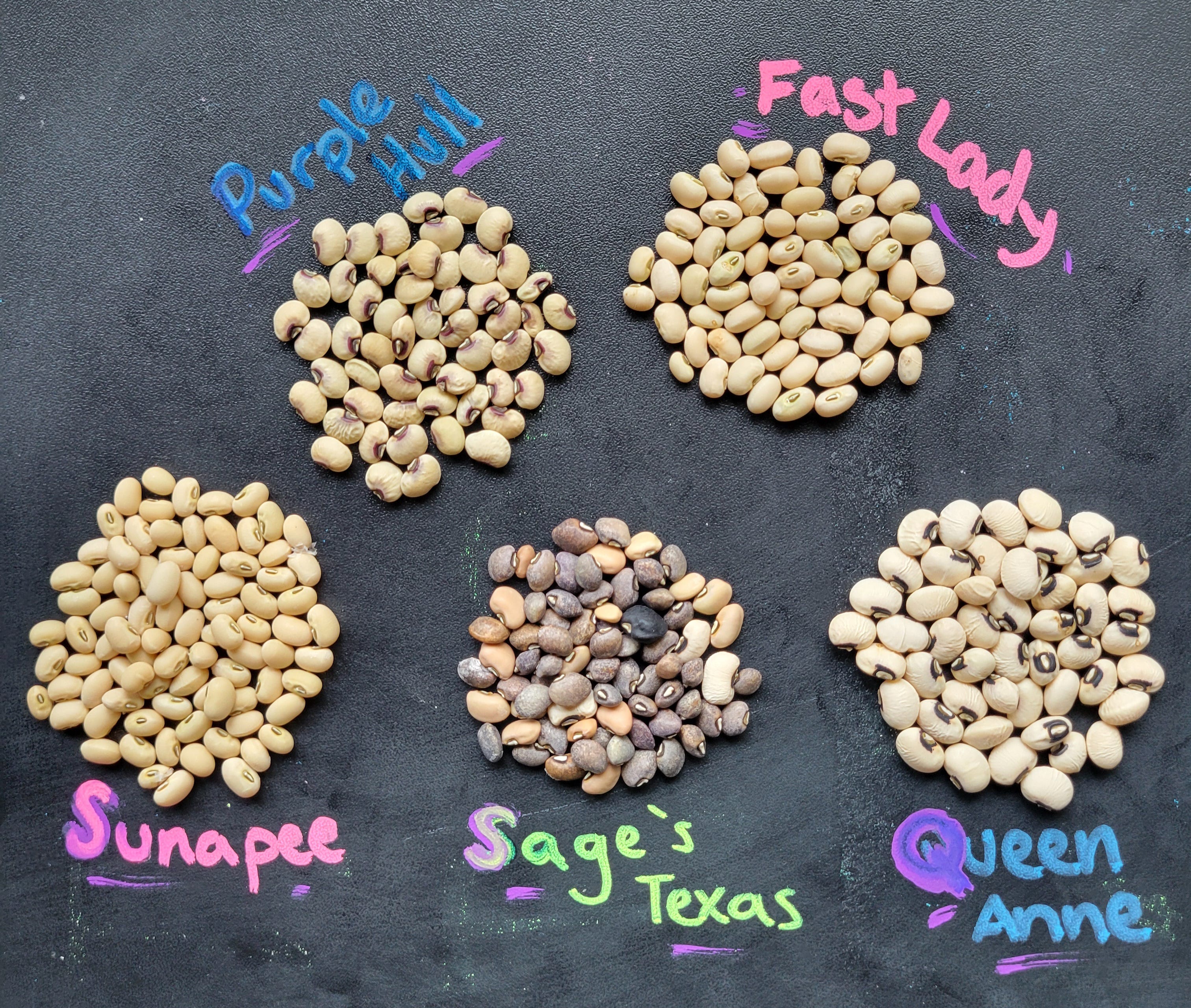
My gateway to growing cowpeas was the variety ‘Fast Lady’. Many varieties of cowpeas take too long to mature in our climate, but after growing ‘Fast Lady’ which matures in 70 days, I realized there are other varieties that mature quickly too. We now grow and offer 7 varieties of short season adapted cowpeas and are always on the hunt for more. This year we are hoping to add a couple more varieties of short season cowpeas if all goes well in the field. Once established, cowpeas are drought tolerant nitrogen fixers that can produce in tough conditions on marginal soils with little added fertility. This makes short season cowpeas a perfect choice for your climate-resilient, organic garden!

A “Reawakened 25” Plant
Over half of all food grown on this planet now comes from 3 species- corn, rice, and wheat. Many are concerned that our over-reliance on these 3 (amazing) plants puts global food systems at extreme risk, especially in this era of climate change.
Lexicon of Food is an international NGO based that brings together food companies, government agencies, financial institutions, scientists, entrepreneurs, and food producers from across the globe to tackle the challenges facing our food systems. One project of the Lexicon of Food has been to consult experts in the fields of agriculture and global food systems to create a list of 25 especially resilient crops that could be of major nutritional importance on a warming planet- The Reawakened 25.
Cowpeas are on this elite list of under-appreciated underdogs! Because of their ability to grow an exceptionally deep tap root, they are a drought resistant source of protein that has historically sustained people on marginal soils all over the world, but particularly in the southern United States where they have a history of being stewarded by enslaved Africans and then black sharecroppers. On the nutrient-stripped soils of the dust bowl era, many sharecropping and tenant farmers got by on cowpeas, collards, and sorghum syrup alone.
African Origins
To understand how cowpeas can produce tasty protein on very little, lets go back to the beginning The wild ancestors of todays cowpea evolved in dry savanna ecosystems in West Africa. This region is one of seasonal rainfalls and nutrient-poor soils. The Sahel region of Africa, which includes modern day Nigeria and Burkina Faso, was the center of domestication and traditional plant breeding that gave us the modern cowpea. This region is still home to the greatest diversity of cowpea varieties.
On the eve of what could be a major resurgence of the cowpea as a drought resistant staple, it is especially important appreciate the African origins of this amazing crop. As Judith Carney and Richard Rosomoff wrote in their 2009 book, In the Shadow of Slavery: Africa’s Botanical Legacy in the Atlantic World, “Africans have contributed more than 100 species to the global food supplies. The plants they gave the world include pearl (bulrush) millet, sorghum, coffee, watermelon, black-eyed pea, okra… tamarind, hibiscus and a species of rice. African contributions to global plant history, however, are largely unacknowledged and seldom appreciated. In the popular image, Africa is a place of hunger and starvation.”
Today, cowpeas are still part of daily life in many parts of Africa, but some traditional dishes involving cowpeas are becoming lesser known. The Slow Food Foundation for Biodiversity has added traditional Ugandan dishes made from cowpeas to their Ark of Taste. The mission of the Ark of Taste is to raise awareness about local food traditions that are believed to be on the verge of disappearing within a few generations. In Uganda, cowpeas are traditionally boiled green in their pods (empogola) or prepared as a soup (enva). Unique to Uganda, a powder called ggobe is also made from cowpea leaves. This powder, which has specific rules and customs around its use and gifting, symbolizes unity and trust among different people who offer it to each other. Ggobe is often prepared together with a sauce of groundnut paste, beans, and other ingredients and is eaten with foods like potato and cassava. Any remaining flour can be stored in banana fiber and hung in a smoky zone in the kitchen for preservation.
Cowpeas and Slavery
Cowpeas spread north from Africa to the Mediterranean through trade routes and were introduced to Mexico and the Southwest by Spanish colonists in the 16th or 17th century. Africans enslaved by the Portuguese also brought cowpeas with them to Jamaica at around the same time. Archaeological evidence shows cowpeas made their way from either the southwest or Jamaica to the southeastern United States where they were being grown by Native Americans by at least 1670. Because cowpeas were a cheap staple grown in Africa, slave ship captain’s logs mention purchasing cowpeas to feed slaves on the horrific Middle Crossing to America. Captured slaves also reported smuggling cowpea seeds in their hair on slave ships for planting wherever they were going.
During slavery in the United States, cowpeas were grown on-scale on some plantations to feed slaves and were also grown in the small gardens of enslaved Africans. Enslavers provided very meager rations of food to the enslaved, especially elderly slaves who could not work very much. Enslaved people often kept small gardens to grow supplemental vegetables and medicinal herbs. Because slaves were working daylight hours on the plantation, this gardening had to be done “by moonlight, aching after a day of heavy plantation labor.” And because plantation owners often gave the enslaved the most marginal land on which to grow, those hidden cowpea seeds were a life saver.
Sharecropping, George Washington Carver, and Great Depression
“Cow peas are to the South what clover is to the North, and alfalfa to the West. And we trust that the time is not far distant, when, as an article of human food, the pea itself will be to the South what the Boston, Navy and White soup beans are to the East and West.”
-George Washington Carver
After slavery, from around 1870 to 1940 the sharecropping system (aka “slavery rerouted) ruled the economy of the south. Most agricultural land remained in the hands of plantation owners despite federal government promises of land for freed black men. Former plantation owners and white farmers had most of the land, most of the tools, and the cash to get yearly necessities like seeds and feed. Poor quality land was “rented” to black farmers and poor white farmers, along with the rental of tools and seeds. Sharecroppers were to somehow use the income from their small plots to sustain themselves, pay their rental debts, and save for the purchase of their own land. A tiny few were able to do this, but the vast majority remained indentured to the land owner as the generations went by.
Cotton depletes soil and had stripped the once rich agricultural soils of the south. On this marginal land, former slaves knew what to grow to sustain their families and here again cowpeas are a plant hero, helping sustain people who had almost no way out of this new system oppression. Sharecroppers grew them because the plants can get by on less of everything, and because of their interconnected history and cultural relationship to the plant.
But it was George Washington Carver who championed the cowpea as a post King-Cotton land healer and protein-rich food. Much more than the peanut man, Carver discovered that nitrogen fixer cowpeas could be used to rebuild the over-farmed soil of the south while also providing a yield. For a fun and dense read about his study of cowpeas, check out his agricultural bulletin on them from 1908. This bulletin, in addition to a 1917 bulletin called How to Grow Cowpeas and 40 Ways of Preparing this Delicacy, were two major publications that got many more farmers and gardeners growing cowpeas and healing their soil.
Cowpeas went on to get farmers through the great depression and dust bowl. When life for those with a little land was less about selling commodities and more about growing for survival, crops that didn’t have much of a market but were great survival foods (like cowpeas) really shined. Today, cowpeas are truly an emblematic food of the American south, and are a symbol of resilience and cultural identity. They are often served in southern style alongside collard greens and rice, cooked in a slow cooker with smoky meat, or as a side dish to barbeque.
Growing Cowpeas
Direct sow 1" deep after all danger of frost has passed. In row spacing is 3" with 8" between rows. Soaking seeds for 2-4 hours can quicken germination time. When they are first germinating, cowpeas seem to have more tender and tasty leaves and can be particularly vulnerable to earwigs and sow bugs who seem to love munching them. For this reason, don’t use mulch like leaves or straw around cowpeas. Bare soil is best as sow bugs and earwigs thrive in mulch. If ear wigs are a problem in your area, planting a little early can help. Though cowpeas are not hardy, you can cover them with row cover if temperatures dip and beat the earwigs by planting before these heat loving pests emerge. Cowpeas eventually outgrow this vulnerability and are quite easy to grow in general. Their umbrella like leaves shade the soil, and they can get by on less water and nutrients than other beans, so plant them in a “tough” part of the garden where more “needy” crops don’t want to grow.
You can harvest cowpeas green when they are young and cook them like snap beans. Just like snap beans they do become fibrous and woody if left on the plant too long. We prefer to wait and eat all of our cowpeas as dry beans. For this, simply let the pods dry down on the plant and harvest them when they are close to fully dry but before the pods shatter and scatter the seeds to the ground. Winnow the dry pods free from the beans by using a fan or the wind to blow off the pods and chaff, allowing the heavy beans to drop into a bucket.

Cooking Cowpeas
Simple cooking of dry cowpeas is so easy! Soak them overnight as you would with any other bean, and then simmer them for 60-90 minutes. They make great additions to stews as the need about the same amount of time to simmer as the firmer root veggies like carrots.
Three great cookbooks which have a lot of cowpea recipes (which call them black-eyed peas and field peas) are:
Simply West African by Pierre Thiam
I am From Here: Stories and Recipes from a Southern Chef by Vishwesh Bhatt
The Blue Zones Kitchen by Dan Buettner
From Simply West African I made Senegalese Peasant Stew with Fast Lady Cowpeas.
From The Blue Zones Kitchen I made Ikarian Longevity Stew with Queen Anne Cowpeas:

African Peas it is!
Many of the varieties and crops we gardeners grow were given their names in entirely different times, and some of them could definitely stand to be updated. Take my personal (un)favorite- the ‘Lazy Housewife’ pole bean. The bean was one of the first stringless beans, making kitchen prep much quicker. The good-humored folks at Grand Prismatic Seeds have chosen to rebrand ‘Lazy Housewife’ as ‘Pragmatic Partner Pole Bean’ and as a pragmatic partner myself, I’m all for this new name!
This deep dive I’ve taken into “cowpeas” has led me to dual-list the cowpeas on our site under the heading of African Peas. I am always learning new things about the history of these varieties, and I want what I’m learning to be reflected in how I present the varieties I grow. I truly hope the name African Peas catches on.